

When most people think about cardiovascular health, they think about cholesterol, blood pressure, or plaque in their arteries.
As a cardiologist, I care about all of those things. But there is another measurement I wish more people knew about: cardiorespiratory fitness, commonly measured by VO₂ max.
VO₂ max tells us how effectively your heart, lungs, blood vessels, and muscles work together to deliver and use oxygen during exercise. But it tells us something bigger than how fast you can run.
It gives us insight into your physiologic reserve—the capacity your body has available not only for exercise, but for life.
Your VO₂ Max Naturally Declines With Age
Aerobic capacity does not remain constant throughout adulthood.
VO₂ max has historically been estimated to decline approximately 5–10% per decade in sedentary adults, and the decline tends to accelerate later in life.
That matters because where you start matters.
Imagine two 45-year-olds. One exercises regularly and has a high VO₂ max. The other is sedentary and already has relatively low aerobic capacity. Both will experience some age-related decline, but the fitter person starts with substantially more physiologic reserve.
Think of it like a retirement account for physical capacity: the more you build before you need it, the more you have available later.
The good news is that this trajectory is not fixed. Regular training can both raise your level of fitness and help slow the rate of decline as you age.
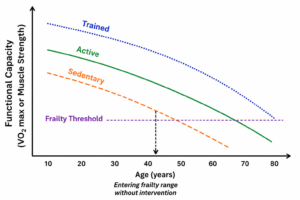
Eventually, aerobic capacity can become low enough that ordinary activities—climbing stairs, carrying groceries, traveling—require a significant percentage of your maximum capacity. Research has proposed VO₂ max levels around 15–18 mL/kg/min as a range where functional independence may become more difficult in older adults.
This isn’t a hard “frailty threshold.” Strength, balance, cognition, chronic disease, and other factors also matter. But it represents a range where functional reserve is becoming limited.
That is why I think of VO₂ max as more than a performance metric.
It is an independence metric.
Fitness Is Strongly Associated With Longevity
Cardiorespiratory fitness is also strongly associated with how long we live.
One large Cleveland Clinic study followed more than 122,000 adults and found that higher cardiorespiratory fitness was strongly associated with lower long-term mortality.
A meta-analysis of 33 studies found that every additional 1 MET of exercise capacity—a standard unit researchers use to measure exercise fitness—was associated with approximately a 13% lower risk of all-cause mortality and a 15% lower risk of cardiovascular events.
These are observational data, so VO₂ max alone doesn’t determine how long you will live. Genetics, smoking, blood pressure, cholesterol, metabolic health, and many other factors matter.
But cardiorespiratory fitness is particularly valuable because it is both highly informative and modifiable.
You can train it.
The Goal Is to Change Your Trajectory
Aging is inevitable. Becoming progressively deconditioned is not.
Exercise doesn’t stop aging, and VO₂ max will eventually decline even in highly trained people. But where you begin and how much fitness you maintain can dramatically change where you end up.
Research in master athletes illustrates this well. In one longitudinal study, sedentary men experienced approximately a 12% decline in VO₂ max per decade, compared with about 5.5% per decade among athletes who continued vigorous endurance training.
That doesn’t mean exercise will cut everyone’s rate of decline in half. It shows us something more important: our fitness trajectory isn’t determined by age alone.
And you don’t need to become an elite athlete.
This is why I don’t want my patients waiting until their 70s to think about maintaining independence. The time to build that reserve is now. The higher we can safely build and maintain our cardiovascular fitness today, the more reserve we carry with us into the decades ahead.
The goal is to create enough cardiovascular reserve that decades from now, the activities required for everyday life remain comfortably below your maximum capacity.
That is healthspan in a very practical sense.
How Do You Improve VO₂ Max?
One foundation is regular aerobic exercise.
I frequently recommend Zone 2 training—moderate-intensity exercise performed at a steady, sustainable effort. Depending on your fitness level, that might be brisk walking, incline walking, jogging, cycling, or rowing.
You can approximate the intensity with the talk test: your breathing and heart rate should be elevated, but you should generally still be able to speak in full sentences.
Depending on the individual, appropriately prescribed higher-intensity intervals can provide an additional stimulus for improving VO₂ max.
And don’t forget strength training. Aerobic capacity and muscle strength are different measures, but both contribute to the physical reserve that helps us remain functional as we age.
The goal isn’t to exercise as hard as possible. It’s to train consistently and progressively enough to change your trajectory.
Know Your Baseline
A laboratory cardiopulmonary exercise test provides the most precise measurement of VO₂ max and can also identify individualized heart-rate training zones. At Nova Wellness, we use this information to make exercise recommendations based on your actual physiology rather than a generic formula.
You can also estimate your aerobic fitness with something as simple as the 12-minute Cooper Test, in which you cover as much distance as you safely can in 12 minutes and then input that data into an online calculator.
However you measure it, don’t think of your score as a grade.
It’s a baseline—and it’s something you can change.
We spend a lot of time talking about lifespan. I think we should spend just as much time thinking about what we want those years to look like.
Can you travel? Carry your groceries? Play with your grandchildren? Climb the stairs? Continue doing the things that make your life yours?
The goal isn’t simply to live longer. It’s to build enough capacity today to keep living independently and well tomorrow.
If you’d like to understand your cardiovascular fitness, VO₂ max, and individualized exercise zones, we can evaluate these as part of your personalized health assessment at Nova Wellness.
This article is for educational purposes and is not a substitute for personalized medical advice.